About this site

My name is Ian Holmes. A few years ago I discovered the branch of motor sport known as road rally. Along with my wife, Lorrie, we road rally our 2014 Ford Focus in regular road rallies and my 1976 MGB in classic road rallies. In 2015 I took over the co-drivers seat for local rally driver Dan Little. This blog describes my adventures in all forms of rallying.

Showing posts with label Road Rallye Gear. Show all posts

Thursday, May 26, 2016

I don't want to be kept in the dark.

Reading pace notes, that is...
Both times I've been out in the 958 on a rally I've needed to use a light to read the notes. The light we use in the 958 is on a flexible neck and has a small conventional lightbulb in it that, in theory, you adjust to where you want it, to shine on your notes to read them. 
Fine and dandy in theory. But the battering a rally car takes means that the light bounces all over the place due to the flexible neck and I end up holding the thing to keep it (relatively) still. Then it starts to get in the way of my reading the notes. Devoting your full concentration to reading is difficult when you're also trying to keep a clear view of the page of notes. Then you have to let go of the light to turn a page in said notes, it springs away from you and you have to reach for it again. 
"What a faff!" As we say back in my home county of Lincolnshire. (What a fuss.) My attention should be on holding the notes and reading them. 
There are ways around this. Like lights mounted to the roll cage for instance. There's a very nice one here, made by Don Barrow in the UK. LED's mounted in some roll cage padding. I think it's a great idea. But at over $100. That's a not inconsiderable amount of money that could go towards an entry fee or a really important car part. It seems to me a much more sensible idea to have your lighting and notes together in close proximity. To that end I came up with my own idea. An illuminated clipboard.
 Now you're all going to say.
But that one on Amazon is a conventional clipboard with a clip at the top. Try turning pages of pace notes on that one in a hurry. 
My concept has a rod at the side that you slide your spiral, or comb bound notes onto so that you can turn the pages freely.
Conventional clipboards are also made of rigid materials so that you can write on the papers clipped thereon. This isn't needed when you're reading notes. So I'd replace that with some kind of more flexible, lower density foam. Because if you have an incident and end up rolling down an embankment it's better to have some foam flying around the cabin rather than wood or a hard plastic.
To me it seems like a blindingly obvious idea and if someone knows of something like this that exists already, I'd be interested to know about it. But so far I haven't found anything.

Tuesday, January 26, 2016

Finding my way

Navigation. It's probably the most important part of Road Rally.
Sure, it takes some driving skill pull up at a timing control exactly on time. But if you aren't on the right road in the first place, then it's a moot point.
Now, the vast majority of the rallies that we have take part in have been simple course following rallies with basic Tulip or some other simple instruction to follow. We tried a trap rally once and hated it. Our brains just aren't wired to deal with cryptic, hidden clues that you have to decipher before calculating your route. 
That's not to say that I'm not interested in other sorts of rallies. I'm always on the look out for other ideas on ways to present rallies with regards to the next Rum Runner (whenever it is) and being of British heritage I look to the home country for ideas. In fact just the other week I came across some instructions for last years "Tour of Cheshire" road rally that involved quite a bit of map reading. I spent several hours on the site plotting the routes on the various legs from the instructions given (even though the correct route was overlaid on the maps).
Now I love maps and map reading. I always have done, right from a very early age. That might be one of the reasons I got into road rally in the first place. I even considered cartography as a career after leaving school. I find looking at maps (particularly the British Ordnance Survey maps) quite relaxing. So looking at these instructions quite naturally got me thinking about how to implement map reading into Rum Runner navigation instructions.
When it comes to maps we Brits are spoiled. Spoiled like you wouldn't believe. The Ordnance Survey have been producing maps since 1791, and these OS maps are wonderfully detailed and with one in your hand and a little basic knowledge it's not too difficult to find your way around some unfamiliar countryside.  
However, when it came to looking for maps of this quality to use for the Rum Runner, I quickly came up against a brick wall. For maps of OS standard just aren't easily available here. Sure there are US Topo maps but they don't carry anything like the level of detail that an OS map does.
Lets look at a few examples.

US Topo map
This is a US Topo map, downloadable for free from the USGS website. It's like some kind of hybrid satellite photo/map, and shows the end of the first half of the Rum Runner this year, (if you can see the road that is).  What good is a map for navigation if you can hardly see the road?
Another US Topo map
This second US Topo map has stripped away the photograph enabling you to see the contour lines and roads more clearly. But shows no other details. There are schools, churches, police stations disused rail lines and other things missing from this map that could be useful for navigation.
MNDoT Highways map
This is a Highways map from the Minnesota Department of Transportation, showing the end of the second half of the Rum Runner. Nice road detail is shown, marking different types of roads. But no other details. There are bars, churches and township halls in this area, all things that could be used to give a Rallymaster a opportunity to create interesting instructions.
An OS map sample.
This then is a much vaunted Ordnance Survey map. Where in the UK, I don't know, I just pulled a random image off the web. I expect it's Scotland, looking at the place names. Just look at the detail in the map. I can see there is a lot of pine forest, a railway line crosses the area from SW to NE as does an electric power line. A castle, phone box, and a church. So much detail for a Rallymaster to get their teeth into. For example, I have marked an A and B on the map. To get from A to B could be straightforward and easy. But let me add some extra instructions.
Use yellow and brown roads only.
Cross over the railway line.
Drive though SH 226 followed by 156. (SH is a "spot height" and is the elevation of a point above sea level you can see several marked on the map thusly .320 for example)
Cross over the railway line again.
This route would take you in a loop over the river up and down some steep hills, and around some sharp right angle bends before getting you to point B.
So much more fun than following Tulips, or any other instructions I think.
Perhaps there are maps of this level of detail available in the US, but I have yet to find them, and that's the great thing about OS maps. They are so easily available.
Lets say I go back to the UK and find out that the Mablethorpe and District Motor Club is putting on a road rally and I want to take part. I can pop into "The Paper Rack" (a small, independent local newsagent) on Seacroft Road and buy the maps I'll need in there it's that easy. If I want to buy maps like this in a store in the US I'd have to go to Outdoor lifestyle stores like Cabelas.
I think rallying could be so much more fun with maps like Ordnance Survey maps to work with.

Sunday, August 31, 2014

Time to turn to the tables.

Sometimes I wonder why I'm so fascinated by the sport of road rally. There's a lot of maths involved and mathematics and I do not get along terribly well. Is seven multiplied by eight 48 or 56? I'm having to count it out in my head right now, and now confirm it on a calculator 7 x 8 is 56. So, how does a mathematical nincompoop like myself cope with this? (Apart, of course from turning the calculating over to the navigator). If you are like me then fear not for these below are here to save you.
Larry Reid's Rally Tables on my dining room table...
These tables do all the hard work for you. I suppose it's not dissimilar to using the logarithm tables that we used to have in school. (Log tables and slide rules? It's getting just like school maths class.)
The book is a plethora of numbers and rallye calculations already worked out for you.
The riveting chapters include: Hundredths of minutes converted to seconds. Seconds converted to decimal parts of minutes. Miles per hour converted to seconds per mile and minutes per mile. But the biggest proportion of the book is given over to the Navigation Tables. Some 89 pages of tables where each speed between 12 and 59.75 mph is listed in tenth of a mile per hour increments along with the time it takes to cover a distance between 1 and 40 miles. 

About as interesting as watching paint dry to the uninitiated, but bread and butter stuff for the Rallyist. Three miles at 23 mph? 7 minutes 50 seconds. 
In the past, having these facts easy to hand must have been quite helpful to a navigator if they were trying to look out for landmarks and follow Rallye instructions while at the same time being bombarded with requests from the driver about their speed and progress. 
Also, you needn't go thinking that modern high tech equipment has replaced them. For one of the first things I was shown on my first Rallye, by a friendly fellow rallyist, and was advised to buy, was a set of Navigation tables on an iPad.
There you go, more Rallye fun, and more maths. I really should have paid more attention at school...

Saturday, August 30, 2014

An old rule for a new rallyist

This is probably one of those posts that will be of interest to those friends of mine who don't road rally and are curious as to what makes it such a fascination for me (and my wife). For you more experienced rallyists the article might illicit a wry smile or two.
The road rally world of today is driven by expensive computers. Big black boxes that sit on the dashboard and tell you how fast/slow you're going in relation to your actual time, how far you've gone/got to go, even counting your time to the perfect arrival time. Even now though these big black boxes are being replaced by iPad apps that do exactly the same for 5% of the price. So it's fun to think back the old days and see what rallyists used then.
This is one of those pieces of equipment. A Stevens Rally Indicator or Stevens Wheel. 
It's basically a circular slide rule. They came in two sizes 6" diameter and 10". This is the six inch version. The ten inch was more popular because of the larger size meant larger, easier to read numbers, especially at night. 
What I'm doing with a slide rule I don't know after my brushes with them in school. I can well remember having a small circular slide rule, when everyone else had a straight rule. 
"So Holmes." Said Rob Morton, maths teacher at Queen Elizabeths Grammar School Alford. " A circular slide rule. Whats three multiplied by two?"
I diligently set to rotating the wheels and sliders to do the calculation.
"Six" I said proudly, having  worked quite hard to get the calculation right. 
"Well done." The teacher said. To this day I'm not entirely sure if he was taking the Mickey or not. I think I heard a few giggles go around the classroom. 
So, how does this disc of plastic work for the rallyist?
As you see, there are three arms. The large one is marked T the two smaller ones E and M. 
When you go out on a rally the first thing you do is check how accurate your cars odometer is compared to the rally official distance on a special "Odo Check" section. This is what the E and M arms are for. At the end of this stage you set the M arm to read the official miles and the E arm to what your cars odometer reads. This takes care any measuring errors. Now set the T arm to the speed for the section of the rally you're ready. In this picture it's set at 43mph. A somewhat brisk pace.
Right, let's say you need to know how long it's going to take you to drive 11miles at the 43mph pace. You move the E arm to 11 and then read off the T arm. It says 19.8 minutes. Point eight minutes? You sound confused. Don't forget you also have the Galco hundredths reading stopwatch from a few posts ago. That's what you'll be using to time the leg.
Easy.
Now let's say you need to know how far you've gone in a certain time. You set the T arm to the amount of time that has passed. Let's say 11 minutes. Then if you look at the reading on the smaller E arm you see it says 6.45. You've travelled 6.45 miles! Calculations like this are the bread and butter of road rally, and I know of contestants who, in this world of the high tech black boxes I referred to at the start of this piece, still use the Stevens Wheel today to great effect. Road Rally is a sport that doesn't have to be run using the highest of tech.
To me it's just a bit of a novelty thing to have at the moment. It would though, be rather fun to compete in a road rally using one. 
After my first brushes with the slide rule at school all those years ago, I never thought I'd buy another one let alone consider using one.

Monday, July 21, 2014

Counting to one hundred

Confession time.
Do you know what the thing is I struggle most with in road rally? 
It's counting to 100.
To be more specific, it's counting in hundredths of a minute that's the problem. After a lifetime of knowing that there are sixty seconds in a minute, having to think that there is another way to count a minute is very difficult, especially at the end of a rally after a five or six hours of hard concentration on driving. 
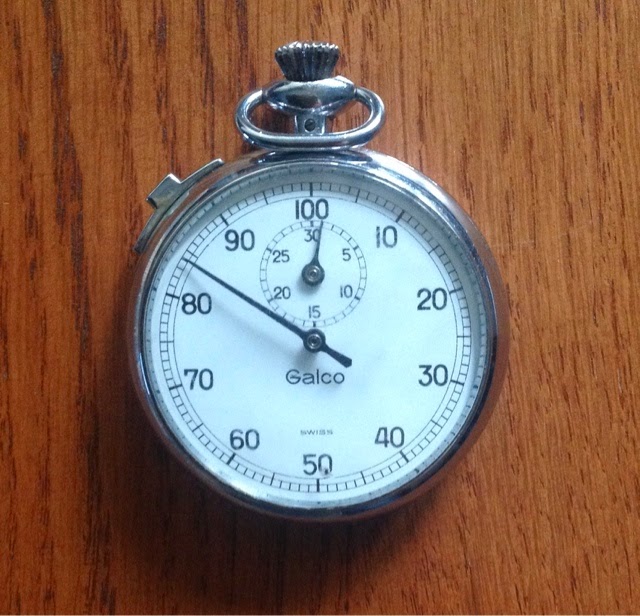
So, for those who read this blog but don't road rally, here's my latest acquisition. A hundredths reading stopwatch. 
If you're anything like me it looks weird the first time. A one hundredth of a minute is six tenths of a second. If you're counting in hundredths and the time to a checkpoint reads 2.33 minutes that's not two minutes 33 seconds that's really two minutes 20 seconds, a whole 13 seconds difference! That piles on the penalty points for sure. So you can see the need to be accurate and totally unconfused by your timekeeping. 
The stopwatch in the picture is reading 0.84 minutes, which in normal time is 50.4 seconds. 
My stopwatch acquired from a member of the Minnesota Road Rally fraternity is a Galco.  It was made in Switzerland by the Gallet company. Although Gallet are unknown to most, they are the worlds oldest watchmaker, their history can be traced back to Humberto Gallet who became a citizen of Geneva 1466, and began making timepieces there. From the 20th century onwards they have become noted for military chronographs and timepieces. President Harry S. Truman even wore a Gallet watch during his presidency. Gallet chronographs were supplied to members of the US Military in Operation Desert Storm. The Galco name on my timepiece indicates the watch was assembled in the USA, probably by the Excelsior Park company, a subsidiary of Gallet, who themselves had the highest reputation as a producer of sports related chronographs. Mechanisms for the watches were made at the home factory in Switzerland and shipped to the factory in Chicago to be placed in the cases that were specially tailored for the American market. The Excelsior Park company went out of business when the sports timekeeping world went digital. Gallet however goes from strength to strength. It's a fascinating history that I have only skimmed in researching this blog entry.
In these days of digital timepieces it's refreshing to listen to the relaxing tikka-tikka-tikka of a quality clockwork timepiece.